

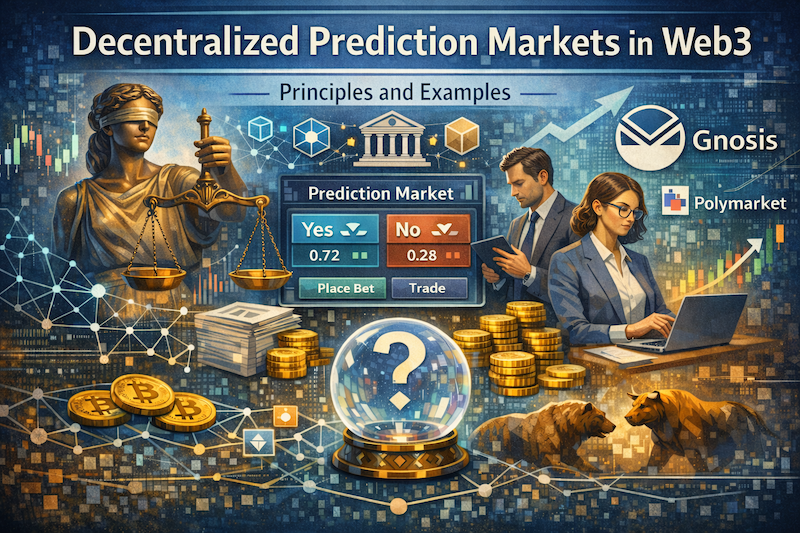
 Decentralized prediction markets are an on-chain mechanism of collective forecasting in which participants’ expectations about future events are transformed into market prices. These prices are interpreted as probabilistic assessments of outcomes and are formed without centralized intermediaries - solely through economic incentives and cryptographically enforced rules. In recent years, prediction markets have become one of the most widely discussed areas in Web3, driven by growing interest in political, macroeconomic, and financial forecasting, as well as by the integration of such mechanisms into DeFi, DAOs, and corporate analytics. This article provides an in-depth examination of the theoretical foundations, architecture, typology, and practical implementation of decentralized prediction markets.
What Is a Prediction Market? Definition and Economic Meaning
A prediction market is a form of speculative market in which contracts linked to the outcomes of future events are traded. Each contract represents a conditional claim whose value depends on whether a specific outcome occurs.
In its classical form, the contract price is interpreted as the market’s aggregated subjective probability of the event. For example, if a contract on a particular outcome trades at a price of 0.72, this implies that the market estimates the probability of that outcome at approximately 72%.
A key feature of prediction markets is that participants risk real resources, which distinguishes them from surveys, expert opinions, and polls. Economic accountability for forecasts acts as a noise-filtering mechanism and incentivizes the search for relevant information.
Theoretical Foundations: Distributed Knowledge and Price Signals
The foundations of prediction markets can be traced to the Austrian school of economics. In “The Use of Knowledge in Society,” Friedrich Hayek argued that information in an economy is inherently decentralized and that the market serves as a mechanism for aggregating this information through price signals.
Prediction markets are a practical embodiment of this idea. Each participant possesses a fragment of information—an insight, an analytical conclusion, experience, or even intuition. Trading contracts enables these fragmented pieces of knowledge to be transformed into a single numerical estimate.
The concept was further developed through the theory of the “wisdom of the crowd” and in the model of futarchy proposed by Robin Hanson. Under futarchy, prediction markets are used not only for forecasting but also for selecting optimal decisions in the governance of states, companies, and decentralized organizations.
Historical Evolution of Prediction Markets
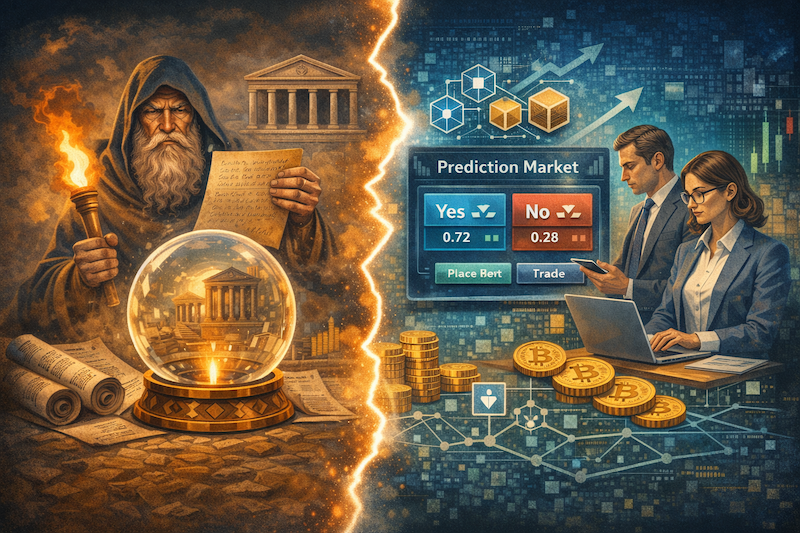
The origins of collective forecasting practices can be found in ancient civilizations—from the oracles of Ancient Greece to the astrological systems of Babylon. However, the transition from symbolic interpretation to market-based mechanisms occurred much later.
In early modern Europe, informal betting on political events became widespread. In the 20th century, the first institutionalized prediction markets emerged in the United States, including the Iowa Electronic Markets, which were used for academic research and demonstrated high forecasting accuracy compared to opinion polls.
Centralized online platforms in the early 2000s expanded access to such markets but encountered regulatory constraints. This became one of the key factors driving the development of decentralized blockchain-based solutions.
The Emergence of Decentralized Prediction Markets in Web3
Decentralized prediction markets began to form with the advent of Smart Contracts on Ethereum and other blockchains. Their primary goals were to eliminate trusted intermediaries, automate settlement, and ensure full transparency of operations.
Unlike centralized platforms, decentralized prediction markets:
- do not hold user funds in a single custodial account;
- use smart contracts for settlement;
- rely on decentralized oracles to determine outcomes;
- are often governed by DAOs or hybrid governance models.
Architecture of a Decentralized Prediction Market
A modern decentralized prediction market typically includes several core components:
- Smart contracts - issue contracts, enable trading, handle clearing, and execute payouts automatically.
- Tokenized outcomes - each possible result of an event is represented as a separate token or conditional asset.
- Liquidity mechanisms - AMM models are often used to enable trading without traditional order books.
- Oracles - deliver real-world data on event outcomes to the blockchain; their reliability is critical.
- Dispute resolution mechanisms - applied in ambiguous or contested outcomes and may involve staking, voting, or decentralized arbitration.
Types of Prediction Markets
From the perspective of structure and complexity, prediction markets can be categorized into:
- Binary markets - two mutually exclusive outcomes;
- Categorical markets - selection of one option among several;
- Scalar markets - forecasting a value on a continuous scale;
- Combinatorial markets - modeling complex scenarios involving multiple variables.
Each type imposes its own requirements on liquidity, interface design, and reward calculation mechanisms.
Key Decentralized Platforms
The most significant projects in the segment include:
- Polymarket - Notable projects in this space include:
- Gnosis - infrastructure provider and developer of Conditional Tokens;
- Augur - one of the earliest Web3 prediction markets;
- Zeitgeist - an appchain for prediction markets experimenting with futarchy;
- SX Network, Polkamarkets, Kleros - specialized solutions for betting, arbitration, and forecasting.
Advantages of Decentralized Prediction Markets
From an academic perspective, key advantages include:
- a high degree of transparency;
- censorship resistance;
- global accessibility;
- automated contract execution;
- integration potential with DeFi and DAOs;
- more efficient aggregation of distributed knowledge.
Limitations and Criticism
Despite their potential, decentralized prediction markets face several challenges:
- insufficient liquidity in certain markets;
- risks of price manipulation;
- dependence on oracle quality;
- legal and regulatory uncertainty;
- difficulty in formalizing complex social and political events.
From an academic standpoint, prediction markets are not a universal instrument of truth, but rather a probabilistic model of collective expectations.
Future Outlook
In the medium term, further institutionalization of prediction markets and their integration into financial and governance systems is expected. Within the Web3 context, key growth directions include:
- on-chain settlement and deep integration with DeFi;
- the use of AI-based oracles;
- application of futarchy within DAOs;
- consolidation of liquidity around major platforms.
In the long term, decentralized prediction markets may become core infrastructure for pricing information in the digital economy.
FAQ - Frequently Asked Questions
What is a decentralized prediction market in simple terms?
It is a platform where people stake cryptocurrency on the outcomes of future events, and smart contracts automatically handle the results without intermediaries.
How do prediction markets differ from betting?
Unlike betting, prediction markets form market prices that can be interpreted as probabilities and allow participants to freely enter and exit positions.
How accurate are prediction markets?
With sufficient liquidity and well-designed incentives, they often outperform traditional polls, but they do not guarantee absolute accuracy.
Are prediction markets legal?
Their legal status depends on jurisdiction and platform structure. Decentralized markets often operate in regulatory gray areas.
Can prediction markets be used to govern DAOs?
Yes, many projects experiment with this approach within futarchy-based governance models.
Conclusion
Decentralized prediction markets are more than just betting on events. They represent an experimental form of knowledge organization in which price becomes the language of probability and blockchain becomes the infrastructure of trust. Their development may significantly transform how decisions are made under uncertainty—from investment strategies to societal governance.