

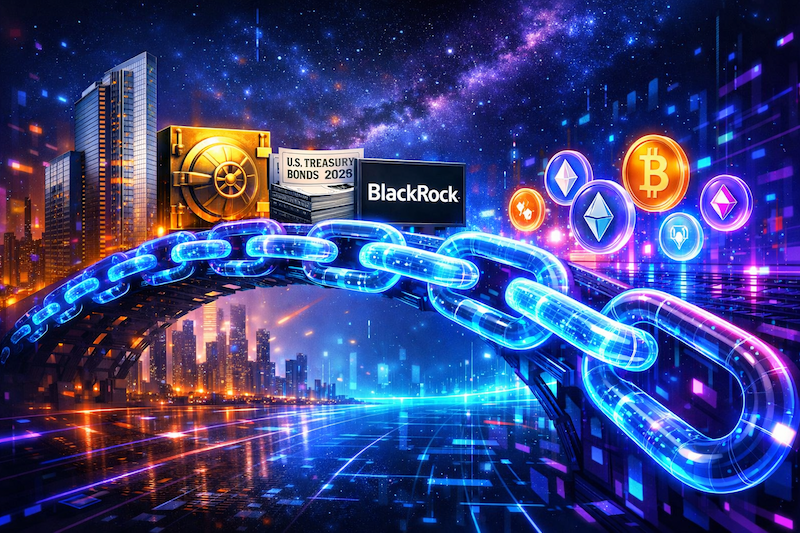
 As of the beginning of 2026, the tokenization of real-world assets (Real World Assets, RWA) has firmly established itself as one of the most dynamic and promising narratives in the crypto industry. According to analytics from RWA.xyz in January 2026, the volume of tokenized RWAs (excluding stablecoins) reached approximately $19 billion, demonstrating steady growth even against the backdrop of overall crypto market volatility at the end of 2025. Let’s take a closer look at what RWAs actually are.
Ethereum remains the leader with a share of more than 65%, but Solana (around $873 million in the RWA ecosystem) and other chains have noticeably strengthened their positions. Key categories include private credit, U.S. Treasury bills (which have surpassed $9 billion), commodities (including tokenized gold, which grew by 227% in 2025), and institutional funds.
The flagship of the sector has become the BlackRock BUIDL fund, whose assets under management (AUM) exceeded $2.3 billion, with expansion across multiple blockchains and integration into DeFi. These are not just numbers: institutional giants such as BlackRock, Franklin Templeton, and JPMorgan have moved from initial tests to full-fledged products, turning RWAs into a genuine bridge between traditional finance (TradFi) and decentralized finance (DeFi).
Key takeaways:
- RWAs allow familiar assets to be placed on programmable blockchain-based templates.
- In 2024–2025, higher yields emerged, MiCA regulation was adopted, and issuers from leading companies entered the space.
- Major barriers have weakened: regulations have become clearer, infrastructure has improved, and the economics have strengthened.
- Developers like Plume, Centrifuge, and Securitize are turning pilot projects into full-fledged products.
The next major shift in crypto: Tokenization of the real world
- 2020 was dominated by DeFi.
- 2021 became the year of NFTs.
- 2023 was the era of layer 2.
Over the past two years, one trend has firmly held its ground and is only gaining momentum: the tokenization of real-world assets (RWA). The numbers confirm this, but the real strength lies in the confidence of the community, making RWA a truly standout phenomenon. In early October 2025, at Token2049, leading industry figures placed tokenization at the center of attention. Vladislav Tenev from Robinhood compared it to a freight train racing toward the financial system. Tom Lee described the structural changes in how Wall Street moves and stores assets. Politicians and developers - from Bo Hines to World Liberty Financial - highlighted tokenized assets as a key entry point for crypto over the next decade. RWAs are increasingly seen as the missing link for global adoption — a rare and genuine “eureka” moment for the crypto sector.
What are RWAs and their main types
Tokenized RWAs are legally recognized or contractual claims on off-chain (real-world) assets, issued as tokens on programmable blockchains. This structure enables the automation of ownership, transfers, distributions, and collateralization through software. A practical way to classify RWAs is by category:
- Cash equivalents: Tokenized money market funds and U.S. Treasury bills, such as Franklin Templeton’s on-chain U.S. government money market fund (Benji), moving accounting and settlement onto the blockchain.
- Commodities: Asset-backed tokens representing stored gold, for example PAX Gold (PAXG), where each token equals one troy ounce of a London Good Delivery gold bar, stored in approved vaults and issued on a programmable ledger.
- Real estate: Tokens reflecting fractional ownership of residential or commercial property, issued through programmable blockchain registries.
- Funds and private credit: Tokenized shares in funds, such as BlackRock USD Institutional Digital Liquidity Fund (BUIDL), and tokenized interests in private credit or loans, increasingly used as on-chain collateral.
- Collectibles: Fractional claims on ownership, for example barrels of whiskey, offered through asset-backed tokenized markets with interests recorded on blockchains.
But if physical versions already exist, why do we need digital twins? Let’s dig deeper.
What real problems do RWAs solve?
Tokenization eliminates real friction in accessing, trading, and servicing assets.
- Access and opportunity - Billions of people still lack access to high-yield financial instruments, even though many are available digitally. Around 900 million unbanked adults own mobile phones, including 530 million with smartphones. Place the corresponding investment products behind a smartphone screen — and you create a real path of opportunity for a huge number of clients.
- Liquidity and fractional ownership - Tokenization allows large, location-bound assets to be divided into smaller investment units and traded on programmable ledgers. This lowers minimum thresholds, expands global investor access, and unlocks potential for continuous secondary trading beyond traditional market hours.
- Faster settlement and improved collateral mobility - Tokenization begins to reduce settlement cycles from T+1 or T+2 to minutes, freeing up capital and reducing operational delays. Recent pilots of digital bonds and asset tokenization demonstrate acceleration and show how tokenized collateral can be reused or moved between platforms more efficiently.
- Composability and automation - RWAs are programmable tokens: whitelists, fee logic, distributions, and transfer restrictions can be embedded in code. This means servicing, compliance checks, and collateral flows can be executed or managed by code.
So if programmable crypto has existed since the first blockchains, why are RWAs only gaining popularity in the mid-2020s?
Why interest exploded in 2024–2025
Two factors converged: yield and trust. With elevated cash rates, investors in 2025 poured record amounts into money market funds, making short-term yield a standard parking place for institutions. This backdrop made on-chain versions of U.S. Treasury bills and money market funds economically attractive, bringing tokenized treasuries to roughly $8.6 billion in circulation.
At the same time, top-tier issuers entered the market. BlackRock’s BUIDL surpassed $1 billion in AUM within a year of launch and grew to around $2.8 billion by October 2025, expanding issuance across several chains. This proved that tokenized funds can scale under major brand managers.
Regulation and government initiatives also fell into place. In the EU, the Markets in Crypto-Assets (MiCA) regulation for stablecoins took effect on June 30, 2024. The broader licensing regime for crypto-asset service providers (CASP) followed on December 30, 2024, giving institutions a clear roadmap.
Meanwhile, the Monetary Authority of Singapore advanced Project Guardian and launched BLOOM (Borderless, Liquid, Open, Online, Multi-currency) - an initiative for settlement in tokenized bank obligations and regulated stablecoins. In Hong Kong, the Monetary Authority created a knowledge base for digital bonds and introduced a grant scheme to subsidize tokenized bond issuance.
Result: clearer adoption paths, lower costs for launching new projects, and faster time-to-market. Together, these factors drove interest in RWAs. Non-stablecoin RWAs on public chains approached $30 billion in 2025 in some estimates. The narrative is shifting from pilots and concepts to broader issuance and distribution.
The real race for RWA infrastructure
- Plume takes the path of an RWA-focused layer-2. It offers Ethereum Virtual Machine (EVM) tools at the base with built-in specialized features such as KYC-gated transfers and whitelists. The project also has a growing list of issuers bringing treasuries, private credit, and fund shares on-chain.
- Centrifuge uses a protocol-oriented approach to tokenization. It connects real assets (invoices, loans, real estate) with on-chain liquidity, turning them into legally structured tokenized representations.
- The Tinlake platform finances various pools of real credit, while collaboration with Sky (formerly MakerDAO) illustrates how tokenized debt can interact with decentralized liquidity systems.
Around them are specialized layers such as Polymesh, focused on permissioned assets with identity binding. Service providers like Securitize manage cap tables, attestations, and compliant secondary transfers. We are still in the early stages, but Plume, Centrifuge, and Securitize are projects worth watching.
Risks, realities, and the path forward
“Early stages” is a serious statement. Readers should pay attention to several challenging issues:
- Legal enforceability of token claims: What exactly do you own and under which court’s jurisdiction?
- Secondary liquidity: AUM ≠ deep market depth; spreads and redemptions can impact price.
- Custody and counterparty design: Segregation, recovery, and audits remain critical.
- Oracles and data integrity: How real-world asset facts get on-chain is extremely important.
- Transfer management, whitelists, and updates: Rules in different countries and tax reporting remain heterogeneous, so distribution may fragment by jurisdiction.
The positive side is that the missing pieces are increasingly coming together: clearer regulations, reputable issuers, bank-grade custody, and programmable settlement infrastructure. RWAs don’t change what an asset is; they change how it is issued, moved, and used as collateral - compressing processes from days to minutes and expanding qualified access. The smart path forward is pragmatic: carefully verify legality, redemption mechanics, disclosures, and market-maker obligations, then scale from narrow use cases to broader distribution. If crypto is the internet of value, then RWAs are how the rest of the financial system plugs in - step by step, with gradual adoption and growing scale.