
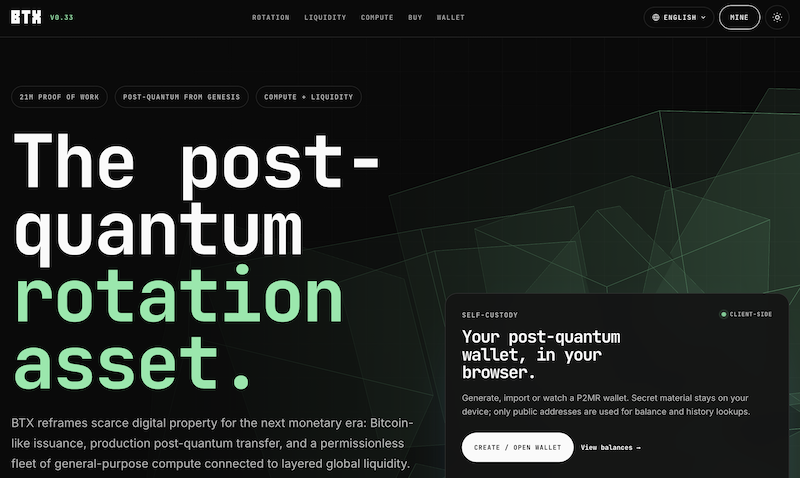
 BTX is a new coin created as a post-quantum rotational asset. BTX rethinks scarce digital ownership for the next era of money: emission following the Bitcoin model, post-quantum value transfer during mining, and a permissionless fleet of universal computing power connected to multi-level global liquidity. This formulation highlights the uniqueness of BTX as an asset ready for future quantum computer challenges, while preserving Bitcoin's core principles and integrating computing resources into the global financial ecosystem. In this material we will review the possibility of mining BTX on modern graphics cards.
Main technologies used in BTX.
- Post-quantum resilience directly from the genesis block.
- GPU hashrate when mining BTX depends on the current network difficulty. As difficulty grows, equipment hashrates may drop.
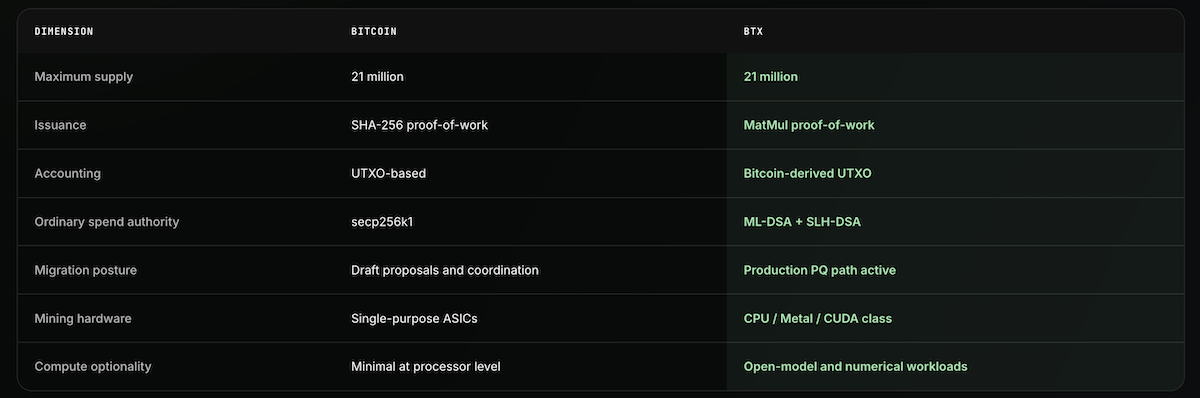
- BTX maintains the rules of a scarce, holder-controlled Proof-of-Work asset, but compared to Bitcoin (BTC) it modernizes two layers that currently limit BTC. Transfer authority and mining utility. As a result, we get one asset with three potential bonuses: monetary scarcity, readiness for post-quantum threats, and sovereign computing.
- Scarcity without corporate buyback, maximum of 21 million coins, open emission through mining and holder-controlled transfers - make BTX a digital commodity even before it becomes a service network.
- Hardware will remain productive thanks to mining using general-purpose computing equipment such as graphics cards (GPU) and processors (CPU). Specialized ASIC devices are not suitable for BTX mining.
- The MatMatul mining algorithm uses GPU and CPU computing capabilities not just for pointless mining, but for running open AI models, agents and useful computations.
- The liquidity engine offers independent roles at each level. Miners, OTC buyers, optimizers, public platforms and third-party services connect through spreads and arbitrage instead of one controlled float.
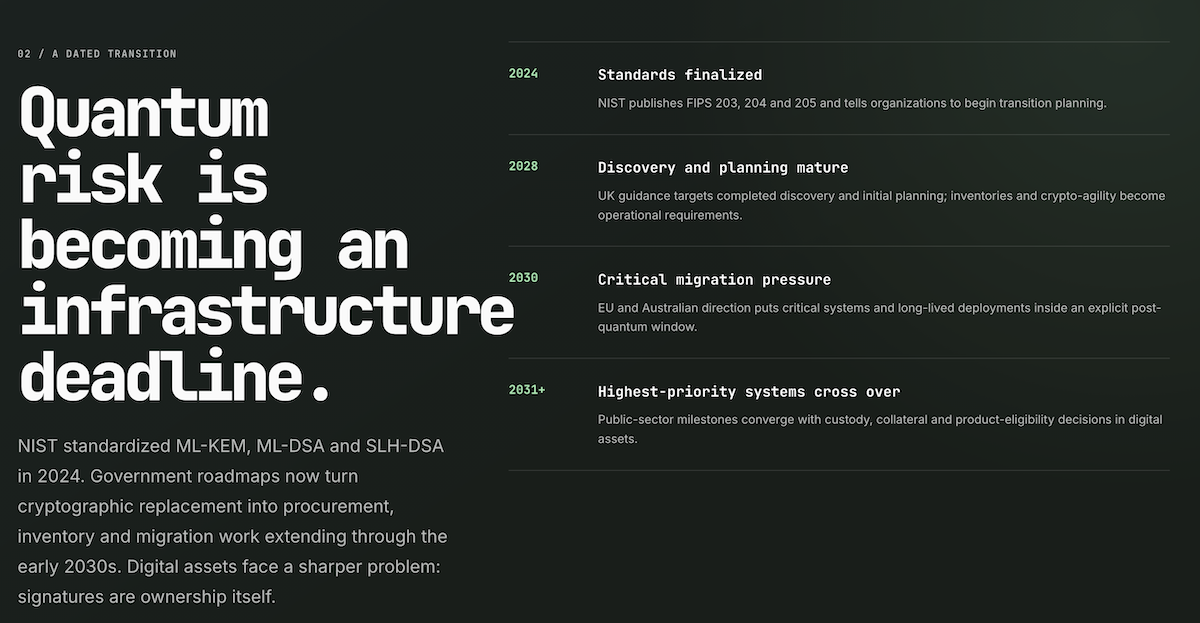
Overview of the BTX coin and its relevance
- Bitcore BTX uses proof-of-work with the matmul algorithm, making it attractive for NVIDIA and AMD graphics cards.
- The coin supports fast blocks and has real liquidity after listing on Safetrade in the BTX-USDT pair.
- The key point is that GPU hashrate depends on network difficulty: as it grows, performance per card may drop, so always check current data on pools.
- Miner updates, including SRBMiner-MULTI v3.4.5, brought improvements for AMD and NVIDIA, bug fixes and efficiency gains.
Main links
- Project website: https://btx.dev
- Source code on GitHub: https://github.com/btxchain/btx
- Available wallets: Full node, Mobile wallet, EasyBTX wallet.
- Mining calculator on the BTXPool pool. Enter your equipment hashrate in kh and the current price from SafeTrade exchange to determine current mining profitability.
- Trading: trading is available on the SafeTrade exchange in the pair with USDT.
- Statistics and information on the BTX coin on Coinpaprika.
- Official BTX Telegram channel.
- Blockchain explorer.
Available miners
- SRBMiner https://github.com/doktor83/SRBMiner-Multi/releases - one of the popular miners recently added BTX mining support. Excellent optimization, custom version for HiveOS.
- PearlFortune https://github.com/pearlfortune/btx-miner - 0% fee, but supported only on Btxpool.
- Matador https://github.com/vanities/matador-miner - 1% fee, one of the leaders in delivered hashrate.
- Nekominer https://github.com/nr800/nekominer - 1% fee.
- Racer https://btx.luckypool.io/racer/racer-0.4.8.tar.gz - suitable for LuckyPool and NinjaRider.
- AMDBTX for AMD graphics cards https://github.com/thekillsquad007/amdbtx
Popular mining pools
- BTXPool https://btxpool.org one of the main pools with support for specialized miners.
- Luckypool https://btx.luckypool.io fee only 1%, PPLNS rewards, convenient statistics and solo mining option.
- Ninjaraider https://ninjaraider.com/btx-pplns fee around 2%, stable payouts.
- Minebtx https://minebtx.com community pool with low fee and weekly payouts.
- Rplant https://pool.rplant.xyz/#btx%23connect also a popular pool.
We recommend LuckyPool or NinjaRider - they show good performance.
How to sell mined coins
- Register on safetrade.com.
- Top up your account or send BTX directly to the exchange address.
- Go to the BTX/USDT pair.
- Sell at market or limit order and withdraw USDT to a convenient wallet.
How to calculate current BTX mining profitability
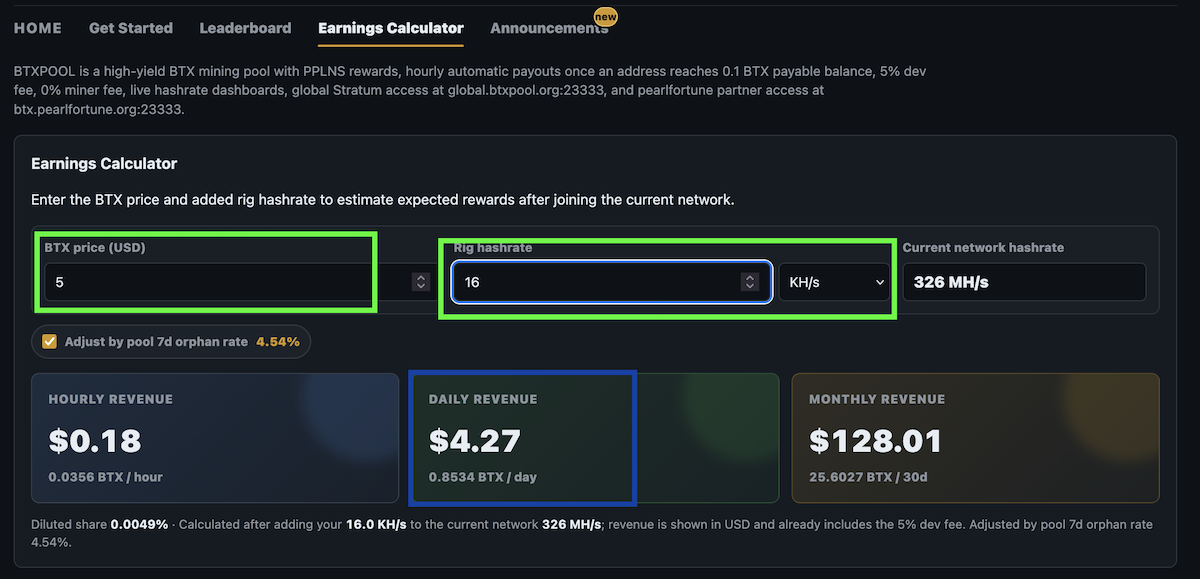
- Go to the calculator section on BTXPool.
- Enter your hashrate from the miner (for example, we currently have 16 KH/s for one Nvidia Geforce RTX 4090). Select KH/s.
- Enter the current coin price in the BTX price (USD) field - you can check the current rate on the SafeTrade exchange. At the moment the coin is trading around 5$ per 1 BTX.
- A bit lower you will see approximate current profitability per hour/day/week. (at the moment 4.27$ per day without electricity for one RTX 4090).
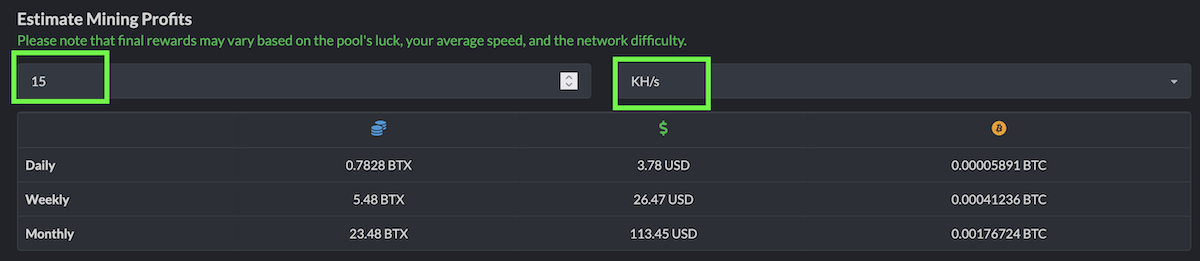
- Luckypool also has its own BTX mining calculator at the bottom of the page - enter your hashrate.
Approximate current equipment hashrates for BTX mining
BTX Miner:
- NVIDIA CMP 50HX: 3-4.35 kh/s (92-210W)
- NVIDIA CMP 30HX: 1.6 kh/s (65W)
- NVIDIA GeForce RTX 3070: 3.1-3.9 kh/s (92-174W)
- NVIDIA CMP 40HX: 1.7-2.1 kh/s (72-106W)
- NVIDIA CMP 90HX: 2.8-3.6 kh/s (135-172W)
- NVIDIA GeForce RTX 5060: 3.45 kh/s (78W)
- Tesla V100-SXM2-32GB: 5 kh/s (268W)
- NVIDIA GeForce RTX 4070 SUPER: 4.9-6.6 kh/s (136-216W)
- MacOS M3 Ultra: 2.1 kh/s
matador-miner:
- NVIDIA GeForce RTX 5090: 21.2 kh/s (404W)
- NVIDIA GeForce RTX 4090: 16.8 kh/s (420W)
- NVIDIA GeForce RTX 5080: 11.4 kh/s (284W)
- NVIDIA GeForce RTX 4080: 11.2 kh/s (297W)
- NVIDIA GeForce RTX 5070 Ti: 10 kh/s (245W)
- NVIDIA GeForce RTX 4070 Ti: 7.9 kh/s (237W)
- NVIDIA GeForce RTX 5070: 7.1 kh/s (185W)
- NVIDIA GeForce RTX 3080 Ti: 7 kh/s (385W)
- NVIDIA GeForce RTX 4070: 6.4 kh/s (189W)
- NVIDIA GeForce RTX 3080: 5.4 kh/s (237W)
- NVIDIA GeForce RTX 4060 Ti: 4.7 kh/s (141W)
- NVIDIA GeForce RTX 3070 Ti: 4.4 kh/s (211W)
- NVIDIA GeForce RTX 3070: 4.3 kh/s (223W)
- NVIDIA GeForce RTX 2080 Ti (-legacy): 4 kh/s (218W)
- NVIDIA GeForce RTX 3060 Ti: 3.5 kh/s (143W)
- NVIDIA GeForce RTX 4060: 3.1 kh/s
- NVIDIA GeForce RTX 3060: 2.7 kh/s (147W)
- NVIDIA GeForce RTX 2060 (-legacy): 2 kh/s (115W)
- NVIDIA GeForce RTX 1080 Ti (-legacy): 1.5 kh/s (167W)
How to start mining
Detailed instructions on how to start mining BTX on different pools and miners.
- How to mine BTX on BTXpool using PearlFortune miner. Settings for HiveOS (Nvidia), Linux (Nvidia, AMD), MacOS.
- How to mine BTX on Luckypool using one of the following miners (SRBMiner, matador, racer, BtxForge, PeakMiner, amdbtx). Linux, Windows, HiveOs. Own mining calculator available at the bottom of the page (enter your hashrate).
- How to mine BTX on NinjaRaider pool using one of the following miners (nekominer, racer, SRBMiner-MULTI, matador). Windows, HiveOS.
- How to mine BTX on MineBTX pool with their own minebtx miner. Linux (Nvidia).
- How to mine BTX on Rplant pool (SRBMiner).
Conclusion: is it worth mining BTX in 2026
BTX offers a real earning opportunity on GPU farms, especially if electricity is cheap. Regularly update miners, monitor network difficulty and test different pools. Combine with other profitable algorithms for maximum profit. Follow updates on our site - we continue to publish fresh guides on promising coins. Good luck with mining and stable payouts!