

 Centralized crypto exchanges continue to lead as the primary tools for storing and exchanging digital assets. Their user-friendly interfaces, instant access to trading operations, wide selection of coins, and additional services like staking, futures, and copy trading attract millions of users worldwide. However, behind this external comfort lies a whole set of serious risks that can lead to partial or complete loss of funds. In this article, we will take a detailed look at why storage on CEX remains popular but extremely risky, list the main threats with real cases, reveal hidden problems, and provide practical recommendations for minimizing losses. If you actively trade or simply hold assets on Binance, Bybit, Coinbase, KuCoin, or other platforms, this article will help you reconsider your security strategy.
Why storing cryptocurrency on exchanges is so popular yet risky
For beginners and experienced traders alike, centralized platforms become a convenient entry point to the crypto market. Registration takes minutes, the interface is intuitive, and deposits and withdrawals often require just a few clicks. There is no need to set up wallets yourself, manage private keys, or delve into the specifics of blockchain networks. This is especially valued by active traders who need high order execution speed, access to margin trading, and the ability to quickly respond to market changes.
However, the main feature of this model is the fundamental lack of control by users. Private keys to wallets are in the hands of the exchange. You do not own the assets directly - you only get access through the platform's account. In case of any problems - be it a technical failure, cyber attack, regulatory sanctions, or financial difficulties of the exchange itself - your funds can be frozen or lost without the possibility of prompt return.
The classic warning was the collapse of FTX in November 2022. The platform, which was considered one of the most reliable and innovative, suddenly suspended withdrawals and soon declared bankruptcy. Thousands of users lost access to their assets, having neither technical nor legal protection. This case still serves as a reminder that trust in centralized structures can turn into serious financial losses. In 2026, despite the development of technology and strengthening regulation, the basic risks have not disappeared.
Main risks of storing crypto assets on centralized exchanges
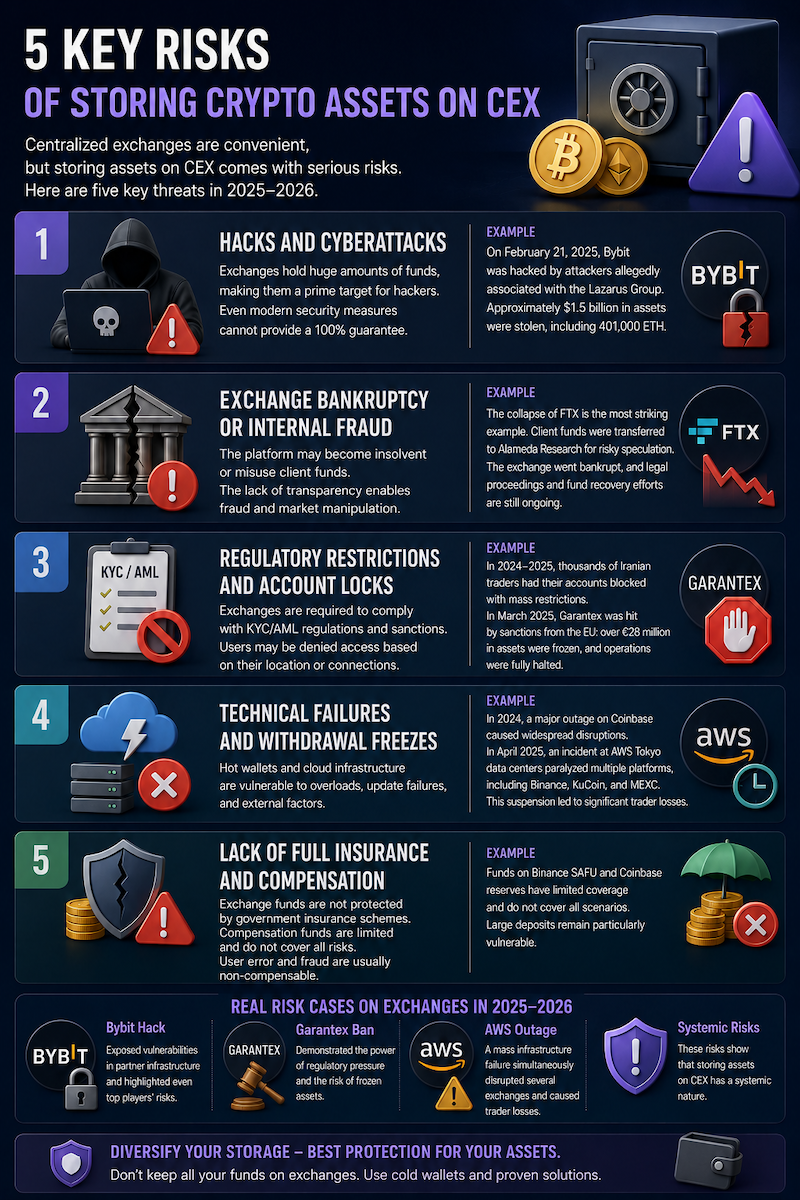
Let's break down the five most common threats that users face this year.
Risk number one - hacks and cyberattacks.
Centralized exchanges accumulate huge amounts of funds, making them the main target for hacker groups. Even modern security measures - cold storage, multi-factor authentication, monitoring systems, and regular audits - do not provide a 100% guarantee.
A vivid example is the Bybit hack on February 21, 2025. Hackers, presumably linked to the North Korean Lazarus group, withdrew about 1.5 billion dollars, including 401 thousand ETH. The attack was carried out through a vulnerability in one of the platform's wallets. Although Bybit promptly compensated the losses from reserves and launched a reward program, the incident demonstrated how vulnerable even the largest market players are. Such events happen regularly and emphasize the need to diversify asset storage.
Risk number two - bankruptcy or internal fraud of the exchange.
When a platform manages client funds, there is always a probability of their misuse. The lack of direct user control opens the way for manipulations.
The collapse of FTX under the leadership of Sam Bankman-Fried became the loudest example. Client deposits were transferred to the related Alameda Research fund for risky speculations and financing third-party projects. After the scheme was exposed, the exchange went bankrupt, and court proceedings for compensation continue to this day. In 2026, financial risks remain relevant - poor reserve management, hidden debts, or fraudulent schemes can lead to the sudden collapse of any platform.
Risk number three - regulatory restrictions and account blocks.
Exchanges are required to comply with strict international KYC/AML norms, as well as sanctions lists. This concerns OFAC, EU regulators, and other bodies. Even loyal users can suffer due to geographic location or indirect connections.
In 2024-2025, thousands of Iranian traders faced mass blocks. A similar case occurred with Garantex in March 2025 - EU sanctions led to the freezing of wallets worth more than 28 million dollars and a complete halt of operations. Users did not get the opportunity for timely withdrawal. In 2026, regulatory pressure is only increasing, making storage on CEX even more unpredictable.
Risk number four - technical failures and temporary withdrawal freezes.
To ensure high transaction speeds, exchanges actively use hot wallets and cloud infrastructures. These systems are sensitive to overloads, update errors, and external factors.
In 2024, Coinbase experienced a large-scale technical failure, due to which users could not see balances and withdraw funds. In April 2025, a failure in AWS data centers in Tokyo paralyzed the work of several platforms at once, including Binance, KuCoin, and MEXC. Even a one-hour stop during high volatility can lead to significant losses for traders who did not have time to react to market movements.
Risk number five - lack of full insurance and compensation.
Unlike bank deposits, funds on crypto exchanges are not protected by state insurance. Compensation funds like Binance SAFU or Coinbase reserves have limited volumes and do not cover all possible scenarios. User errors, phishing, or data leaks are usually not compensated at all. This makes large deposits especially vulnerable.
Real cases of exchange risks in 2025-2026
In addition to the incidents already mentioned, the market has seen many other events. The Bybit hack showed the risks of partner infrastructures. The Garantex block highlighted the power of regulatory measures. The massive AWS infrastructure failure affected several major players at once and led to real financial losses for traders. These cases prove that the risks are systemic in nature.
Hidden risks that are often kept silent
In addition to obvious threats, there are less noticeable problems. Some exchanges may use client funds to maintain their own liquidity, internal transfers, or credit operations without full user notification. Hot wallets, which make up 5-10% of reserves, remain a constant attack vector. The human factor - bribery of employees or data leaks from contractors - also poses a serious danger.
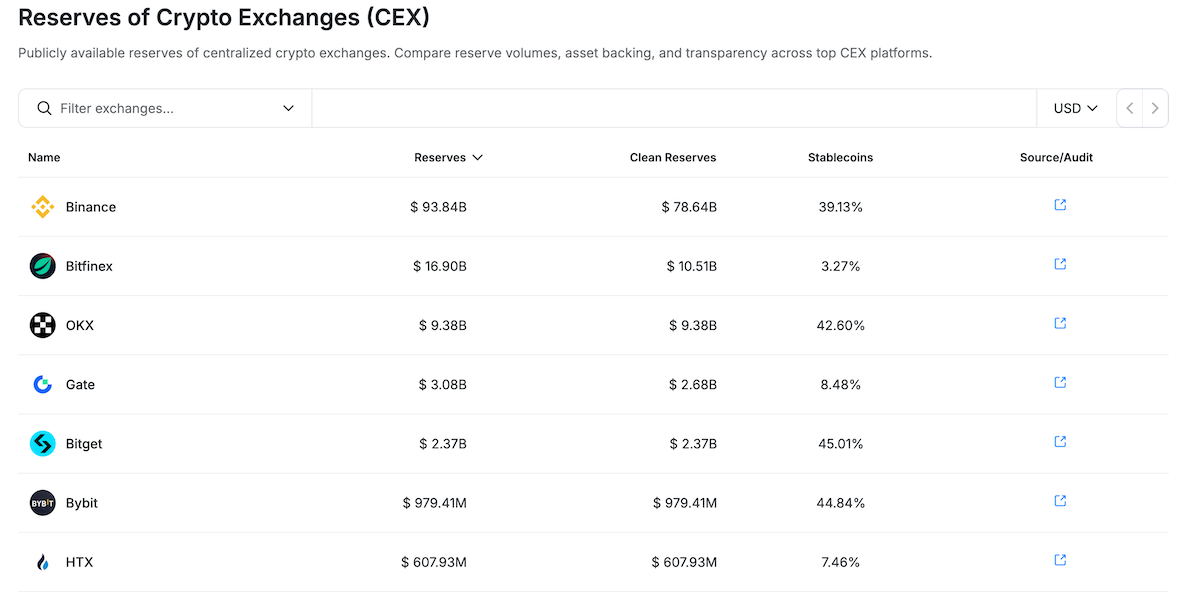
The lack of full transparency in asset management (even with the publication of Proof-of-Reserve) reduces trust. Users do not know exactly where and how their funds are stored, and in what operations they are involved.
How to minimize risks when using centralized exchanges
If you continue to work with CEX, follow strict rules:
- Store on the exchange only the funds that you plan to use for trading in the near future. Withdraw the main part of the portfolio to external wallets.
- Be sure to enable two-factor authentication, anti-phishing code, and whitelist of withdrawal addresses.
- For large amounts, use hardware wallets Ledger or Trezor.
- Choose platforms with regular independent audits and verifiable reserve reports.
- Store funds in Web3 wallets, and trade whenever possible on DEX (perp-Dex - if you need derivatives such as perpetual futures with leverage).
Alternative ways to store cryptocurrency
For long-term storage, non-custodial solutions are optimal. Hardware wallets provide maximum protection of private keys from online threats, although they require careful handling of the seed phrase. Software wallets like Metamask, Rabby, or Trust Wallet give full control and convenience of interaction with DeFi protocols. The choice depends on your needs - trading convenience or maximum security.
New risks of storing funds on exchanges in 2026
This year, regulatory pressure has increased, complex attacks using AI bots, deepfakes, and malicious browser extensions have appeared. These tools allow scammers to create fake pages, generate convincing phishing messages, and steal data unnoticed. The risks of infection through browser plugins are especially relevant for Web3 wallet users.
In general, centralized exchanges remain an important part of the crypto infrastructure, offering convenience and liquidity. However, full dependence on them is dangerous. Understanding all the risks and competent diversification of storage is the key to preserving your crypto portfolio in 2026.