
 Many beginners in cryptocurrency trading overlook exchange fees, only to discover that trades which initially appeared profitable end up generating losses. This is especially noticeable in futures trading with high leverage, where trading costs can quickly eat into your profits.
In this guide, we'll explain the different types of crypto exchange fees, how they are calculated, and the best strategies to minimize them. By optimizing your trading costs, you can significantly improve your overall profitability.
For this article, we'll use Bybit as an example. However, the principles discussed apply to virtually every major cryptocurrency exchange. While fee structures, VIP programs, and discounts may vary from platform to platform, the way trading fees are calculated is largely the same.
You can compare crypto exchanges by commission size on this page of the website: Cryptocurrency exchanges
Spot vs. Futures Trading: Which Market Should You Choose?
The first question you may have is whether to trade on the Spot Market or the Futures Market.
The key difference is that the spot market involves trading actual cryptocurrencies. For example, after purchasing Bitcoin on the spot market, you can withdraw it to your personal crypto wallet.
With futures trading, this is not possible because you are trading contracts rather than the underlying asset.
On the other hand, spot trading fees are typically 2–5 times higher than futures trading fees (assuming you use limit orders). Therefore, for short-term speculative trading opening and closing positions within the same day or over several days we recommend using the futures market, even if you do not intend to use leverage (simply set your leverage to 1x).
The spot market is generally better suited for long-term investing because, unlike futures, there are no additional funding charges or position maintenance costs. The trading fee is fixed and charged only once when you buy or sell.
Futures Trading Fees
As mentioned above, futures trading is usually more cost-effective for active traders due to its lower trading fees. If you execute many trades throughout the day, the savings can become substantial.
In many cases, the money saved on fees can represent a significant portion of your overall trading profits.
Limit Orders vs. Market Orders
On the futures market, fees depend heavily on the type of order you place.
If you submit a limit order that is added to the order book rather than executed immediately, you pay the lower maker fee. On Bybit, this fee is approximately 0.036%.
If you place a market order, which executes immediately, you pay the higher taker fee of 0.1%, roughly the same as spot trading fees.
Perpetual vs. Expiring Futures
There are two types of futures contracts:
Perpetual Futures
Expiring (Delivery) Futures
Expiring futures have a fixed expiration date. With these contracts, you only pay trading fees when opening and closing a position.
However, the selection of available cryptocurrencies is much smaller, liquidity is lower, trading volume is reduced, and spreads (the difference between buy and sell prices) are often wider than on perpetual futures.
Funding Fees
When trading perpetual futures even without leverage you may either pay or receive funding payments depending on market conditions.
Positive funding: Long position holders pay Short position holders.
Negative funding: Short position holders pay Long position holders.
Funding payments occur every 8 hours.
The opening and closing trading fees are generally the same for both perpetual and expiring futures (at least on Bybit; other exchanges may differ).
Which Futures Contract Should You Choose?
When deciding between perpetual and expiring futures, first check the funding rate.
If you receive funding, perpetual futures are usually the better choice.
If you must pay funding, compare that cost with the wider spread on expiring futures.
If the spread on expiring futures is lower than your expected funding cost, using expiring futures may reduce your overall trading expenses and improve your profitability.
Understanding Leverage and Trading Fees
One of the biggest mistakes beginners make is forgetting that leverage increases trading fees proportionally.
For example, if you use 10x leverage, your opening and closing commissions are effectively 10 times larger because they are calculated based on the total position size rather than your own capital.
Many traders overlook this and end up closing positions at a loss, even though their trading terminal still shows an unrealized profit.
Example:
Suppose you have 1,000 USDT and open a 10x leveraged Long position worth 10,000 USDT using a market order.
A 0.1% trading fee is charged on the 10,000 USDT position, which equals 10 USDT.
Although the exchange charges only 0.1%, you personally are paying 10 USDT from your own 1,000 USDT, meaning your actual cost is 1% of your capital.
Since you pay the fee both when opening and closing the trade, your total trading cost becomes approximately 2%.
Therefore, your trade must earn at least 2% profit just to break even.
How to Set Stop Loss and Take Profit with Lower Fees
By default, Bybit executes both Stop Loss and Take Profit orders as market orders.
This means you pay the higher taker fee.
On Bybit futures:
Taker (Market Order): 0.1%
Maker (Limit Order): 0.036%
As you can see, the taker fee is almost three times higher, which can significantly reduce your profits over time.
Fortunately, Bybit allows you to close futures positions using limit orders, enabling you to pay the much lower maker fee.
How It Works
Open the Stop Loss / Take Profit window.
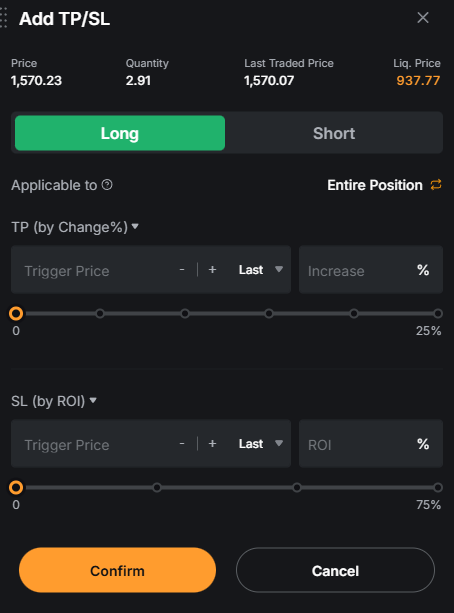
By default, positions are closed using market execution.
Click the small "Entire Position" option. This reveals additional settings, including "Limit Exit."
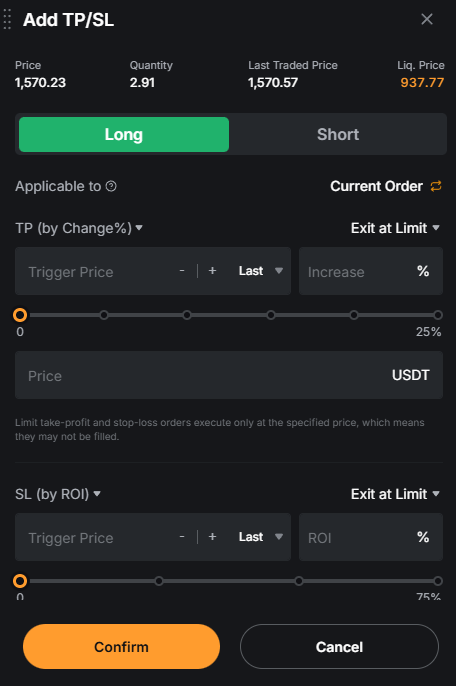
Although this may seem complicated initially, the logic is straightforward.
The Trigger Price is the price that activates your limit order.
The Limit Price is the actual price at which your order will be placed.
Take Profit Example
Suppose you entered a Long position at 1,000 USDT.
To execute Take Profit as a maker order:
Trigger Price: 1,050 USDT
Limit Price: 1,060 USDT
When the market reaches 1,050 USDT, Bybit automatically places your limit sell order at 1,060 USDT.
If the market reaches that price, your position closes using a maker order, reducing your trading fee by roughly three times compared to a standard market Take Profit.
Stop Loss Example
The same principle applies to Stop Loss orders.
Simply place both the trigger price and the limit price below your entry price when closing a Long position.
Conclusion:
If you actively trade cryptocurrencies, always pay close attention to trading fees. They have a direct impact on your overall profitability and are one of the few aspects of trading that you can fully control.
Unlike market movements, trading costs are predictable and measurable. Every dollar you save on commissions is effectively guaranteed profit.
Start optimizing your trading strategy with exchange fees in mind, and you'll likely see a noticeable improvement in your long-term trading performance.